Loading Events

A View of One’s Own showcases landscape drawings and watercolours by British women artists working between 1760 and 1860, whose work represents a growing area of The Courtauld’s collection. These artists range from highly accomplished amateurs to those ambitious for more formal recognition. They have remained mostly unknown, and their works largely unpublished.

When the Royal Academy was founded in 1760, its members included two women, yet there would not be another female academician until Dame Laura Knight was elected in 1936. Despite this institutional exclusion, women artists in Britain continued to train, practice, and exhibit during this period, particularly in the field of landscape watercolours.

This exhibition and its accompanying catalogue shed new light on these artists, working within a heavily male dominated era in the arts. Some of the artists achieved recognition during their lifetimes, while others’ work remained private, until later discovered.

10 artists are featured in the exhibition. They include Harriet Lister and Lady Mary Lowther, who were among the first to depict the Lake District; Amelia Long, Lady Farnborough, one of the first British artists to travel to France following the Napoleonic Wars; and Elizabeth Batty – whose works appearing in the show were only rediscovered a few years ago.

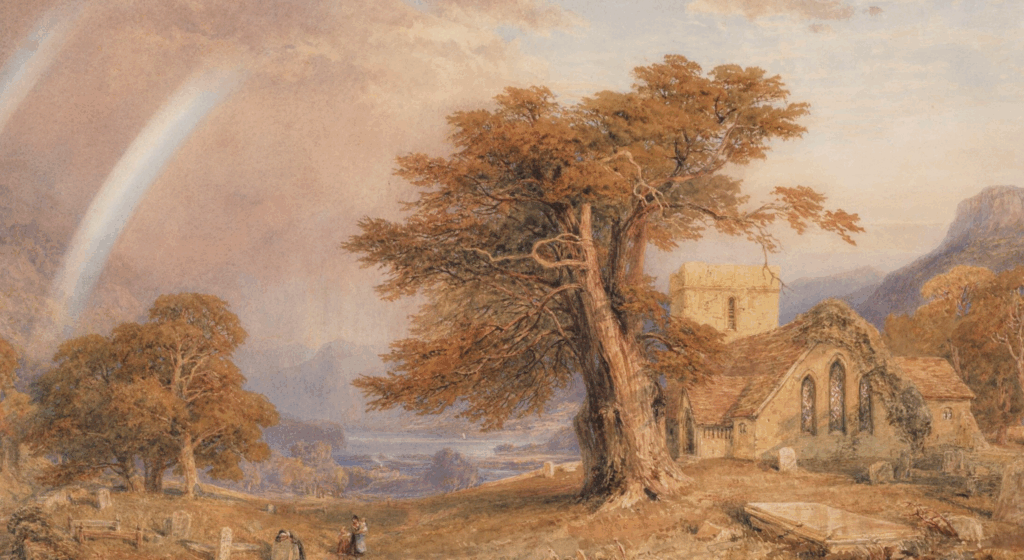
Image: Fanny Blake (1804-1879), A rainbow over Patterdale Churchyard, Cumbria, 1849, Watercolour and opaque watercolour over graphite, with scratching out, on wove paper. Jointly owned by the Samuel Courtauld Trust and the Wordsworth Trust. Gift from a private collection in memory of W. W. Spooner, 2025. Photo © The Courtauld
Current, Exhibitions
Share:

A View of One’s Own: Landscapes by British Women Artists, 1760-1860

A View of One’s Own showcases landscape drawings and watercolours by British women artists working between 1760 and 1860, whose work represents a growing area of The Courtauld’s collection. These artists range from highly accomplished amateurs to those ambitious for more formal recognition. They have remained mostly unknown, and their works largely unpublished.

When the Royal Academy was founded in 1760, its members included two women, yet there would not be another female academician until Dame Laura Knight was elected in 1936. Despite this institutional exclusion, women artists in Britain continued to train, practice, and exhibit during this period, particularly in the field of landscape watercolours.

This exhibition and its accompanying catalogue shed new light on these artists, working within a heavily male dominated era in the arts. Some of the artists achieved recognition during their lifetimes, while others’ work remained private, until later discovered.

10 artists are featured in the exhibition. They include Harriet Lister and Lady Mary Lowther, who were among the first to depict the Lake District; Amelia Long, Lady Farnborough, one of the first British artists to travel to France following the Napoleonic Wars; and Elizabeth Batty – whose works appearing in the show were only rediscovered a few years ago.

Image: Fanny Blake (1804-1879), A rainbow over Patterdale Churchyard, Cumbria, 1849, Watercolour and opaque watercolour over graphite, with scratching out, on wove paper. Jointly owned by the Samuel Courtauld Trust and the Wordsworth Trust. Gift from a private collection in memory of W. W. Spooner, 2025. Photo © The Courtauld
Date

January 28, 2026 – May 20, 2026

Venue
Address
The Courtauld Institute of Art, Somerset House, Strand
London, WC2R 0RN United Kingdom

More Events

Events, Upcoming
The Drawing Competition 2026
The National Arts Club
May 2, 2026 10:00 am
Events
Tour of Shadow Visionaries: French Artists Against the Current, 1840-70
Clark Art Institute
February 27, 2026 1:00 pm
Events
Close Looking with the Curator: Brooklyn Bridge from the New York Municipal Archives
The Metropolitan Museum of Art
February 17, 2026 5:30 pm
Events
A Celebration of John Wilson
The Metropolitan Museum of Art
February 3, 2026 6:00 pm

Join The Drawing Foundation community