An Exploration of Robert Rauschenberg’s Drawings
Led by Helen Hsu, Associate Curator for Research, Robert Rauschenberg Foundation
Join us for this rare opportunity to tour the studio of Robert Rauschenberg (1925-2008). We’ll have the opportunity to look closely at the artist’s drawings and go through the installation Robert Rauschenberg: NASA Artist and Cloud Correspondent, which explores Rauschenberg’s interest in and use of NASA press photographs across a variety of media that expand our understanding of how the artist used drawings.
__
Robert Rauschenberg: NASA Artist and Cloud Correspondent
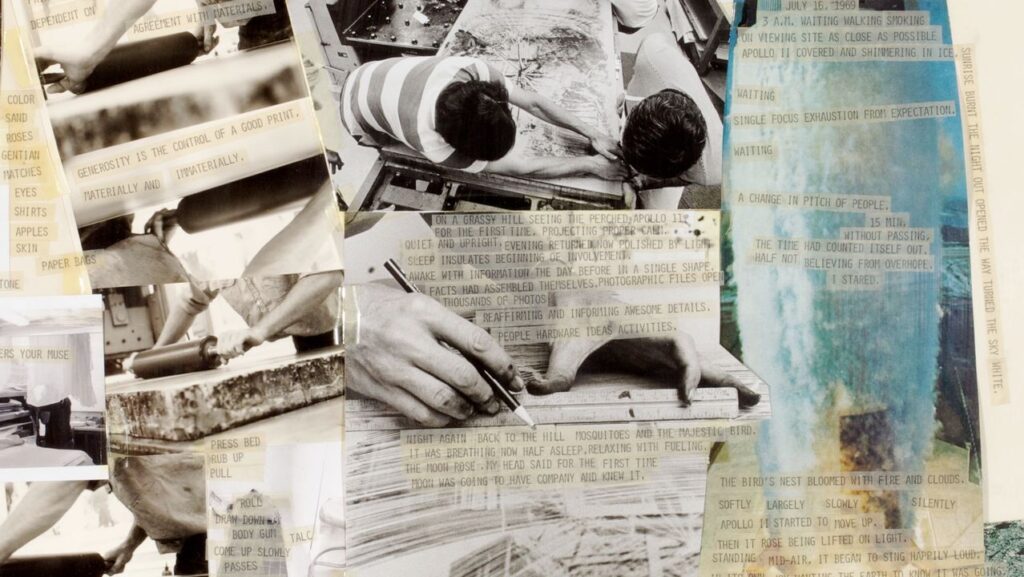
Robert Rauschenberg was an artist who pulled life into his art. As he told his biographer Calvin Tomkins, “I think I relate more to society than to any idea about art history. I feel the world is here to do something about and with.” In 1969, when the National Aeronautics and Space Administration (NASA) Art Program invited him to witness the launch of Apollo 11—the first spaceflight to land astronauts on the moon—Rauschenberg jumped at the opportunity. The NASA Art Program had developed in 1962 to supplement the precise scientific photographic documentation with artworks that captured the “inner meaning and emotional impact” of NASA’s space efforts. True to this spirit, Rauschenberg excerpted, layered, and transformed imagery from NASA press photographs into a suite of more than thirty Stoned Moon editions made at Gemini G.E.L. in Los Angeles and an illustrated plan for a book.
The works in this exhibition draw out Rauschenberg’s focus on space through evocative artwork titles and skyward focused imagery. In 1988, he scrawled down his thoughts on an airline ticket sleeve mid-flight to Newark Liberty Airport, identifying himself as a “cloud correspondent.” As a soaring messenger, his references to astronauts, celestial bodies, and an urge to gaze at—and travel through—the sky permeated beyond his Stoned Moon series, starting with his earlier transfer drawings of the 1950s and 1960s and his silkscreen paintings (1962–64). The references continued unabated in works from Rauschenberg’s later artwork series, included in this installation: Gluts (1986–94), Rauschenberg Overseas Culture Interchange (ROCI; 1984–91), Urban Bourbons (1988–96), and Scenarios (2002–06). In 1991 the artist reflected, “I even feel restricted with the world as small as it is already. I’m trying to take advantage of as much of it as possible. I’m old enough that I probably won’t run out of land, but I would like to go to the moon.”
This installation was curated by Julia Blaut, Senior Curator and Kristen Clevenson, Assistant Curator; selections from the Robert Rauschenberg Foundation archives were made by Francine Snyder, Director of Archives. It complements The Ascent of Rauschenberg: Reinventing the Art of Flight, curated by Carolyn Russo (Rauschenberg research resident, 2019), opening July 1 at the Smithsonian’s National Air and Space Museum in Washington, D.C.
About the Robert Rauschenberg Foundation:
The Robert Rauschenberg Foundation builds on the legacy of artist Robert Rauschenberg, emphasizing his belief that artists can drive social change. Rauschenberg sought to act in the “gap” between art and life, valuing chance and collaboration across disciplines. As such, the Foundation celebrates new and even untested ways of thinking.
The Foundation and archive operates out of 381 Lafayette Street, Rauschenberg’s former studio and home.
___
This event is open to members of The Drawing Foundation. Log in to your membership account to register or sign up to become a member today.
This event is organized by The Drawing Foundation in partnership with the Robert Rauschenberg Foundation as part of On Drawings 2026.
Image: Robert Rauschenberg (1925-2008), Stoned Moon Drawing, 1969 (detail). Photographs, typewritten paper, Polaroids, printed reproductions, and crayon on illustration board. © Robert Rauschenberg Foundation